

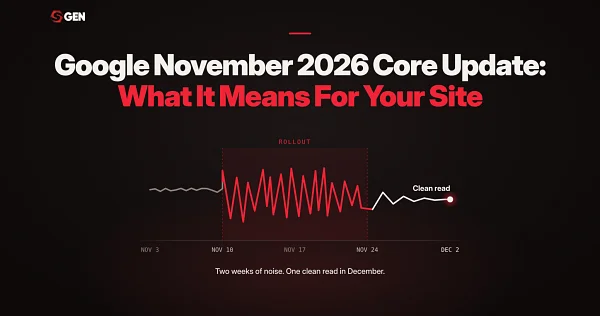



Google started rolling out its November 2026 core update on November 10, 2026, and the rollout may run until around November 24. If your rankings or traffic moved this week, this update is the most likely cause. But movement this early doesn't tell you where your website will end up.
The update at a glance
- Update: November 2026 broad core update
- Started: November 10, 2026, 10:06 a.m. Pacific (early November 11 in Asia)
- Rollout length: Up to 2 weeks, according to Google's Search Status Dashboard
- Scope: Global, all languages
- Google's description: A regular update to better surface relevant, satisfying content from all types of sites
- New guidance: None specific to this update
This is Google's third core update of 2026, after March and May. It comes after the longest gap between core updates this year, about five and a half months. Ranking trackers had already picked up volatility in the days before Google confirmed it.
Why your numbers look so unstable
Rankings move every day during a core update, and they only settle after the rollout ends. A drop on day two can reverse by day ten, so early data is a poor guide.
Three things are adding noise this week:
- Ranking swings. Core updates change how Google weighs content across the whole web. Pages can drop, recover and drop again while the rollout runs.
- Reporting lag. Search Console data usually runs a couple of days behind. Search Engine Roundtable also flagged a data bug in Search Console's Generative AI performance report for November 9 to 11. Some dips may be in the reporting, not in your actual visibility.
- AI search changes. On the same day the update started, Google made a new model, Gemini 4 Carbon, available in AI Mode for subscribers. AI Overviews and AI Mode keep changing how many clicks reach websites.
In short, this week's data mixes real movement with noise. You need the full rollout and a clean comparison to tell them apart.
When to assess the impact
The earliest fair read is around December 2, not two weeks from now. Google advises waiting until the rollout finishes, then waiting at least one more full week before comparing data.
Compare that post-rollout week against the week before November 10. Black Friday (November 27) and Cyber Monday fall inside the comparison window, so allow for the normal holiday swings in your industry. If Google takes longer than two weeks, as past November updates have, every date shifts later.
What to do during the rollout
Whether you run one site or fifty, the basics are the same: save a baseline, watch the data, rule out technical problems, and hold off on big changes until the rollout is done. How that looks day to day depends on who you are.
For small businesses
You probably have one site and limited time to watch it. Keep it simple:
- Save a baseline. Export your Search Console data for November 3 to 9, the last clean week before the update.
- Watch sales and leads, not just rankings. Calls, form fills and orders tell you more than a daily ranking report. Note any real change and when it happened.
- Keep publishing as planned. Helpful, people-first content is still what Google rewards. Don't rewrite or delete pages based on a few days of data.
- Don't panic over a dip. Core updates are not penalties. A drop this week can reverse before the rollout ends.
- Spread your holiday bets. Plan Black Friday and Cyber Monday campaigns around email and paid ads as well as organic search.
If you'd rather spend less time on the technical side, SGEN for small business gives you one fast, well-built site so you can focus on running the business.
For agencies and freelancers
You're managing many sites at once, and clients will be asking questions this week. Stay systematic:
- Baseline every property. Save November 3 to 9 Search Console data for each site you manage, before it ages out of easy reach.
- Monitor key pages and queries. Track rankings, clicks and impressions per site, and flag anything that moves outside normal ranges.
- Rule out technical causes first. Check for crawl errors, broken pages and tracking problems before blaming the update.
- Freeze big changes. No redesigns, migrations or large rewrites mid-rollout. Changing pages now makes it impossible to tell what caused what.
- Log everything. Record any site changes with dates, and ask clients to flag shifts in sales or leads so you can match them to search data.
- Set expectations early. Tell clients the first fair read comes in early December, and plan a full impact review once the data is clean.
If you run many client sites, SGEN for agencies lets you manage your whole portfolio from one dashboard. Freelancers can build on SGEN and hand sites off to clients when the work is done.
Google hasn't issued new advice for this update. Its standing guidance still applies: sites that focus on satisfying, reliable content for people have nothing special to do.
The bottom line
Volatility right now is expected, and it's happening across the industry. Save your baseline, keep your site stable, and wait for the full picture in early December before drawing conclusions.
If your traffic is still down after December 2, that's the time to dig into which pages and queries lost ground, and why. If it's up, look at what those pages are doing well so you can do more of it.
Frequently asked questions
What is a Google core update?
A core update is a broad change to Google's ranking systems that affects how it evaluates content across all sites, worldwide. Google runs several each year, and the November 2026 update is the third of 2026. Core updates aren't aimed at any single site or type of site; they aim to better surface relevant, satisfying content.
What should I expect during a core update?
Expect rankings and traffic to move up and down day to day while the rollout runs, which can take up to two weeks. Early dips often recover, and a drop isn't a penalty. Search Console data also lags a couple of days, so wait for the rollout to finish before judging the impact.
When can I tell if my site was affected?
Around December 2. Google recommends waiting until the rollout finishes, then at least one more full week. Compare that week against November 3 to 9, the last clean week before the update, and allow for Black Friday and Cyber Monday swings.
Should I make changes to my website during the rollout?
Keep publishing helpful content as planned, but hold off on redesigns, migrations and large rewrites. Changing pages mid-rollout makes it hard to tell whether the update or your changes caused any movement.